
Hue was Vietnam's imperial capital under the Nguyen dynasty, and its citadel, tombs and pagodas are among the country's best-preserved. It is a slower, more reflective stop than Hoi An. Here is how to see it.
Hue's historic monuments were the first site in Vietnam to be inscribed on the UNESCO World Heritage List, in 1993, and in 2025 the province became a centrally governed city. Its pace is slower than Hanoi's or Saigon's, and its cuisine, shaped by the royal court, is considered one of the most refined in the country.
The best things to do in Hue
1. The Imperial City (Dai Noi)
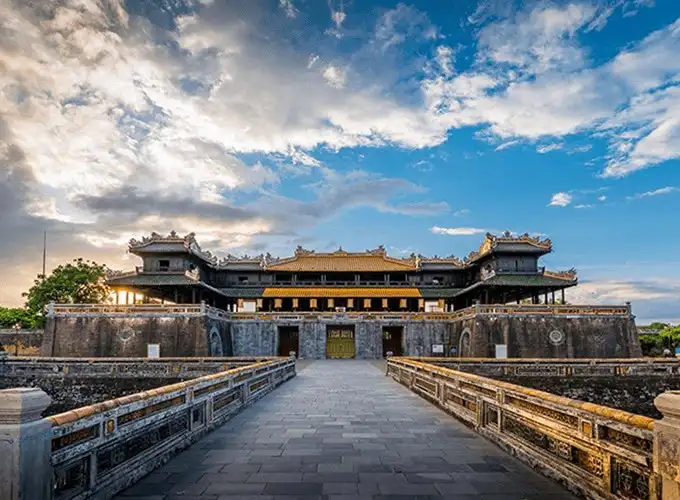
A walled palace complex with more than a hundred buildings, entered through the Ngo Mon Gate and centered on the Thai Hoa Palace. Pick a few highlights instead of trying to see everything. Adult tickets were reported at about 200,000 VND in 2025, with cheaper combined tickets that include royal tombs; confirm current prices on arrival.
Allow at least half a day for the Imperial City. Highlights include the Ngo Mon Gate, the Thai Hoa Palace (the throne hall), the restored Hien Lam Pavilion with the Nine Dynastic Urns, and the Forbidden Purple City, much of which was destroyed in 1968 and is being rebuilt. Early morning and late afternoon are the coolest times to visit. On some evenings the palace opens for night visits, with lighting and cultural performances.
2. The royal tombs
- Khai Dinh: the last great tomb of the dynasty, about 10 km from the center, mixing Vietnamese and European styles. Opening hours are reported as about 6:30 to 18:00 from mid-March to mid-October and 7:00 to 17:30 from mid-October to mid-March.
- Minh Mang: about 12 km out, a calm, symmetrical complex of lakes and pavilions.
- Tu Duc: built in the 1860s among pine groves and lakes, a favorite for its quiet beauty.
The tombs are far apart. A combined ticket and a driver save time.
Visiting tip: the tombs of Minh Mang and Khai Dinh are on opposite sides of the river, so plan your route with your driver. Khai Dinh has a steep flight of steps, and its interior is decorated with mosaics of porcelain and glass. Tu Duc's tomb, with its lake and pavilions, is the best for a slow walk.
3. Thien Mu Pagoda
A seven-story tower on a hill above the Perfume River. It is free and open all day; go early morning or late afternoon.
4. A Perfume River cruise
Take a boat in the late afternoon for the sunset light.
6. Royal cuisine and street food
Hue's food is famous throughout Vietnam. Try bun bo Hue, a spicy beef and lemongrass noodle soup; com hen, rice with baby clams and herbs; and the small steamed rice cakes, banh beo, banh nam and banh loc, often served together. A dinner of royal-style dishes in a garden house is a memorable way to end the day.
7. Garden houses and Dong Ba Market
Hue's traditional garden houses (nha vuon), with fruit trees, ponds and wooden homes, were the residences of mandarins and royal families. Some, such as An Hien, can be visited. Dong Ba Market, near the river, is the city's busiest, with stalls of conical hats, sesame candy and street food.
8. Thanh Toan tile-roofed bridge
About 8 km east of the city, this wooden bridge with a tiled roof, built in the 18th century, crosses a canal in the rice fields. Cycle there through the villages for a peaceful half day.
9. Tam Giang Lagoon
Northeast of Hue, the Tam Giang–Cau Hai lagoon system is one of the largest in Southeast Asia, lined with fish traps and fishing villages. Go at sunset, when the light reflects on the water and the fishermen return.
10. Bach Ma National Park
Between Hue and Da Nang, Bach Ma rises from the coast to cool, forested heights, with waterfalls, birdlife and the ruins of colonial-era villas. It is a good day trip for walkers.
11. Vong Canh Hill and the Perfume River at night
For a view of the Perfume River winding through the hills, climb Vong Canh Hill in the late afternoon. In the evening, the Truong Tien Bridge is lit in changing colors, and the riverside walking street is busy with locals.
5. Day trips
See our Hue ancient capital tour, the DMZ and Vinh Moc tunnels tour and the A Luoi day trip.
The DMZ and the war sites
North of Hue, the former Demilitarized Zone around the 17th parallel divided North and South Vietnam from 1954 to 1975. A full-day tour usually includes the Vinh Moc tunnels, where villagers lived underground during the bombing, the Hien Luong Bridge on the Ben Hai River and sometimes Khe Sanh. Hue itself was the scene of one of the war's longest battles in 1968, and a good guide can show you its traces in the city.
How many days in Hue?
- One day: Imperial City and Thien Mu Pagoda.
- Two days: add two or three tombs and a river cruise.
A 2-day Hue plan
- Day 1: the Imperial City in the morning, lunch of Hue specialties, Thien Mu Pagoda and a sunset boat on the Perfume River.
- Day 2: the tombs of Tu Duc, Khai Dinh and Minh Mang by car, a garden house dinner, and Truong Tien Bridge at night.
With a third day, add the DMZ, Bach Ma or a cycling trip to the Thanh Toan bridge.
Where to stay in Hue
Most hotels are on the south bank of the Perfume River, within walking distance of the riverside, the night market and restaurants, and a short cyclo ride from the citadel. For a historic stay, Azerai La Residence occupies the former French governor's residence on the river. Homestays and small guesthouses inside the citadel walls offer a quieter, local experience. If you want a resort, the lagoon and beach areas east of the city, toward Thuan An and Tam Giang, have hotels with pools and sea views, about 20 to 30 minutes from the center.
Festivals
Hue hosts cultural festivals throughout the year, with royal court music (nha nhac, recognized by UNESCO), traditional crafts and night performances at the Imperial City. The program changes each year, so check the city's events calendar before you travel.
Where should I stay in Hue?
On the south bank of the Perfume River for restaurants and easy access to the citadel, or at a lagoon or beach resort east of the city.
Getting around Hue
The citadel and the riverside are easy to explore on foot or by cyclo, the traditional bicycle rickshaw. The tombs are spread out along the river south of the city, so hire a car or motorbike driver for the day, or take a boat trip that stops at Thien Mu and one or two tombs. Phu Bai airport is about 30 minutes from the center, and the scenic train to Da Nang along the coast takes about two and a half to three hours.
Getting here and when to go
Hue is a short drive from Da Nang over the Hai Van Pass (see things to do in Da Nang). Central Vietnam is wettest in autumn; January to March is generally drier. See best time to visit Vietnam.
Where to stay
See Azerai La Residence Hue and our Hue destination page, or browse history and UNESCO tours.
Planning more of the trip? Read our guides to Things to Do in Hoi An, Vietnam and Vietnam Itinerary.
Things to do in Hue: FAQ
How many days do you need in Hue?
One to two days.
What is Hue famous for?
The Imperial City, royal tombs and royal cuisine.
Is Thien Mu Pagoda free?
Yes, entry is reported as free.
Is Hue worth visiting?
Yes, for history and a quieter pace.
Which tomb is best?
Khai Dinh for architecture, Tu Duc for atmosphere.
What should I eat in Hue?
Bun bo Hue (spicy beef noodle soup), com hen (clam rice) and the steamed rice cakes banh beo, banh nam and banh loc.
Can I visit the DMZ from Hue?
Yes. A full-day tour visits the Vinh Moc tunnels, the Hien Luong Bridge and other sites of the former Demilitarized Zone.
Hue attractions: what to see in Hue city, the facts and the weather month by month
Hue was the capital of Vietnam under the Nguyen dynasty from 1802 to 1945, and its Complex of Hue Monuments was the first Vietnamese site inscribed on the UNESCO list, in 1993. October is the wettest month in these averages (about 773 mm); February, March and April are the driest.
What to see in Hue
- Complex of Hue Monuments
- UNESCO World Heritage Site (1993) made of three concentric enclosures: the Citadel (outer wall), the Imperial City and the Purple Forbidden City
- Royal tombs
- Tombs of the emperors Gia Long, Minh Mang, Thieu Tri, Tu Duc, Duc Duc, Dong Khanh and Khai Dinh lie outside the city, several along the Perfume River
- Thien Mu Temple
- The largest pagoda in Hue and the official symbol of the city, on the Perfume River
- Thai Hoa Palace
- The principal ceremonial hall of the Nguyen emperors; its throne was reinstated in its original position in June 2026 after restoration, according to Wikipedia
Hue today
- Status
- In 2025 Hue became a centrally-governed city, merged with the rest of the former Thua Thien Hue province
- River and lagoon
- The Perfume River runs through the city; the Tam Giang-Cau Hai lagoon is the largest lagoon in Southeast Asia (68 km long)
Hue weather by month (1991–2020 averages)
- January
- Highs 23.5°C, lows 17.5°C; about 129 mm of rain on 15.5 rainy days
- February
- Highs 24.5°C, lows 18.2°C; about 63 mm of rain on 11.6 rainy days
- March
- Highs 27.5°C, lows 20.2°C; about 51 mm of rain on 10.2 rainy days
- April
- Highs 31.1°C, lows 22.7°C; about 59 mm of rain on 9.2 rainy days
- May
- Highs 33.5°C, lows 24.5°C; about 111 mm of rain on 11.7 rainy days
- June
- Highs 34.7°C, lows 25.3°C; about 103 mm of rain on 9.3 rainy days
- July
- Highs 34.7°C, lows 25.2°C; about 95 mm of rain on 8.5 rainy days
- August
- Highs 34.2°C, lows 25.1°C; about 139 mm of rain on 10.7 rainy days
- September
- Highs 31.7°C, lows 24.1°C; about 411 mm of rain on 16.3 rainy days
- October
- Highs 29°C, lows 22.8°C; about 773 mm of rain on 20.8 rainy days
- November
- Highs 26.5°C, lows 21°C; about 642 mm of rain on 20.9 rainy days
- December
- Highs 23.8°C, lows 18.6°C; about 350 mm of rain on 20.2 rainy days
Hue has under 100 mm of rain a month only in February to April, July on these averages, so it is wet for most of the year; the heavy months are September to December.